How Flying Measures Up Against Everyday Risks: New Embry-Riddle Study Puts Air Travel Safety Into Perspective
PR Newswire
DAYTONA BEACH, Fla., May 28, 2026
A new study from Embry-Riddle's Boeing Center for Aviation and Aerospace Safety aims to inform the public about the safety of flying by demonstrating U.S. commercial aviation risk side by side with risks experienced through other activities, such as driving, recreational pursuits, household hazards, and common jobs and actions.
DAYTONA BEACH, Fla., May 28, 2026 /PRNewswire/ -- Feeling nervous about flying lately? New analysis of aviation safety data from Embry-Riddle Aeronautical University may ease some of those concerns among the flying public.
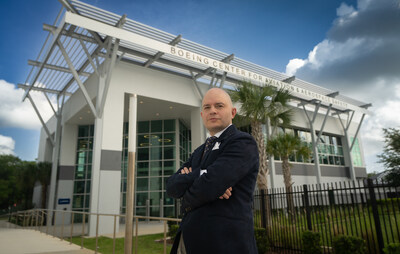
The newly released multi metric study from Embry-Riddle's Boeing Center for Aviation and Aerospace Safety aims to inform the public about the safety of flying by demonstrating commercial aviation risk side by side with risks experienced through other activities, such as driving, recreational pursuits, household hazards, and common jobs and actions. The report will be updated periodically with emergent information.
"Across all metrics considered, airline travel consistently emerges as the safest mode of transportation," said Robert L. Sumwalt, executive director of the Boeing Center for Aviation and Aerospace Safety and former National Transportation Safety Board chairman.
An aggregation of data across recent years and uses, the report, titled "Comparative Risk Metrics for U.S. Commercial Aviation (Part 121)," defines multiple ways of measuring aviation risk exposure to produce stable, comparable estimates for aviation safety. These include per passenger mile, trip or event, hour of exposure, annual risk and lifetime odds.
Ultimately, the findings highlight the exceptional safety of modern commercial aviation and provide an evidence-based foundation for assessing aviation risk within the broader landscape of human activity.
The report notes that "fatal events in commercial aviation are now exceedingly rare." That conclusion is backed by the numbers. On a distance basis, the study finds U.S. commercial aviation produced roughly one fatality per 90.9 billion passenger miles over the analysis period — a rate far lower than highway travel, motorcycle riding or cycling, according to the report.
The study's lead author, Dr. Mihhail Berezovski, associate professor of Mathematical Sciences and director of Undergraduate Research at Embry-Riddle, said the comprehensive multi metric approach gives the public a clearer basis for judgment.
"We want to give people correct, thorough and broad information so that they can assess risk rationally," Berezovski said. "By looking at multiple complementary measures, we can conclude that aviation's safety performance is not an outcome of one assessment methodology. Rather, it is a consistent result across distance, time and event based perspectives."
Beyond direct comparisons, the report also emphasizes that different questions require different metrics. For example, a traveler's intuitive concern about a single trip is best addressed by per-event risk, whereas public health comparisons consider annual or lifetime measures. Using these metrics, the study found that a single airline boarding is far less risky than a day of skiing or a recreational scuba dive, and an hour spent flying is generally safer than an hour spent driving or working in many occupations.
Berezovski further explained that the university's role is to translate technical analysis into a context usable by the public.
"This report helps people place aviation risk in the broader context of everyday activities and occupations," he said. "It's natural to feel fearful or worried after an accident, but decisions — both personal and policy-related — should be based on reliable data, not just fear based on a single event."
The findings are meant to educate rather than celebrate safety success across the industry, according to the experts at the Boeing Center for Aviation and Aerospace Safety.
Sumwalt said aviation safety is the result of decades of global standardization, data driven oversight and continuous technological and regulatory improvement. But he stressed that the findings are not grounds for complacency.
"Low risk does not mean no risk," Sumwalt said. "The aviation community must continue to learn from every accident, incident and near miss. This analysis gives us a clearer baseline from which to measure progress."
Embry-Riddle President P. Barry Butler, Ph.D., commended the center for producing the novel research.
"For over a century, Embry Riddle has acted as a leader in aviation and aerospace safety," he said. "By integrating academic analysis and industry partnerships with public outreach, we're committed to advancing the national conversation on risk and to providing the data and tools that regulators, airlines and the traveling public need to keep improving safety."
The full report, Comparative Risk Metrics for U.S. Commercial Aviation, is available online through the Boeing Center for Aviation and Aerospace Safety and is intended to inform policymakers, industry stakeholders, the media and the public. The publication will be updated periodically.
About Embry-Riddle Aeronautical University
Reporters worldwide contact Embry-Riddle Aeronautical University for content experts in all aspects of aviation, aviation business, aerospace, engineering and STEM-related fields. Our faculty experts specialize in uncrewed and autonomous systems, security and intelligence, air traffic and airport management, astronomy, human factors psychology, meteorology, spaceflight operations, urban air mobility and much more. Visit the Embry-Riddle Newsroom for story ideas.
Embry-Riddle educates over 31,000 aspiring aerospace and aviation professionals at its residential campuses in Daytona Beach, Florida and Prescott, Arizona, and across more than 115 Worldwide Campus locations and online degree programs. In 2024, U.S. News & World Report named Embry-Riddle Worldwide the nation's No. 1 provider of online bachelor's degree programs among private universities. Our residential campuses hold multiple Top 10 rankings. All of our campuses have been ranked Best for Veterans.
Media Contact:
Seth Robbins
Director of news and media communications
386-241-6060
Robbins1@erau.edu
 View original content to download multimedia:https://www.prnewswire.com/news-releases/how-flying-measures-up-against-everyday-risks-new-embry-riddle-study-puts-air-travel-safety-into-perspective-302784890.html
SOURCE Embry-Riddle Aeronautical University